Accepted executed replay
Nominal, overload, pH shock, temperature disturbance, reduced HRT, high solids, recovery and boundary challenges.
Every row retains methane yield, VFA/ALK, stability state, upper bound and violation flag.
Overload and boundary conditions move the virtual soft sensor away from the stable regime.
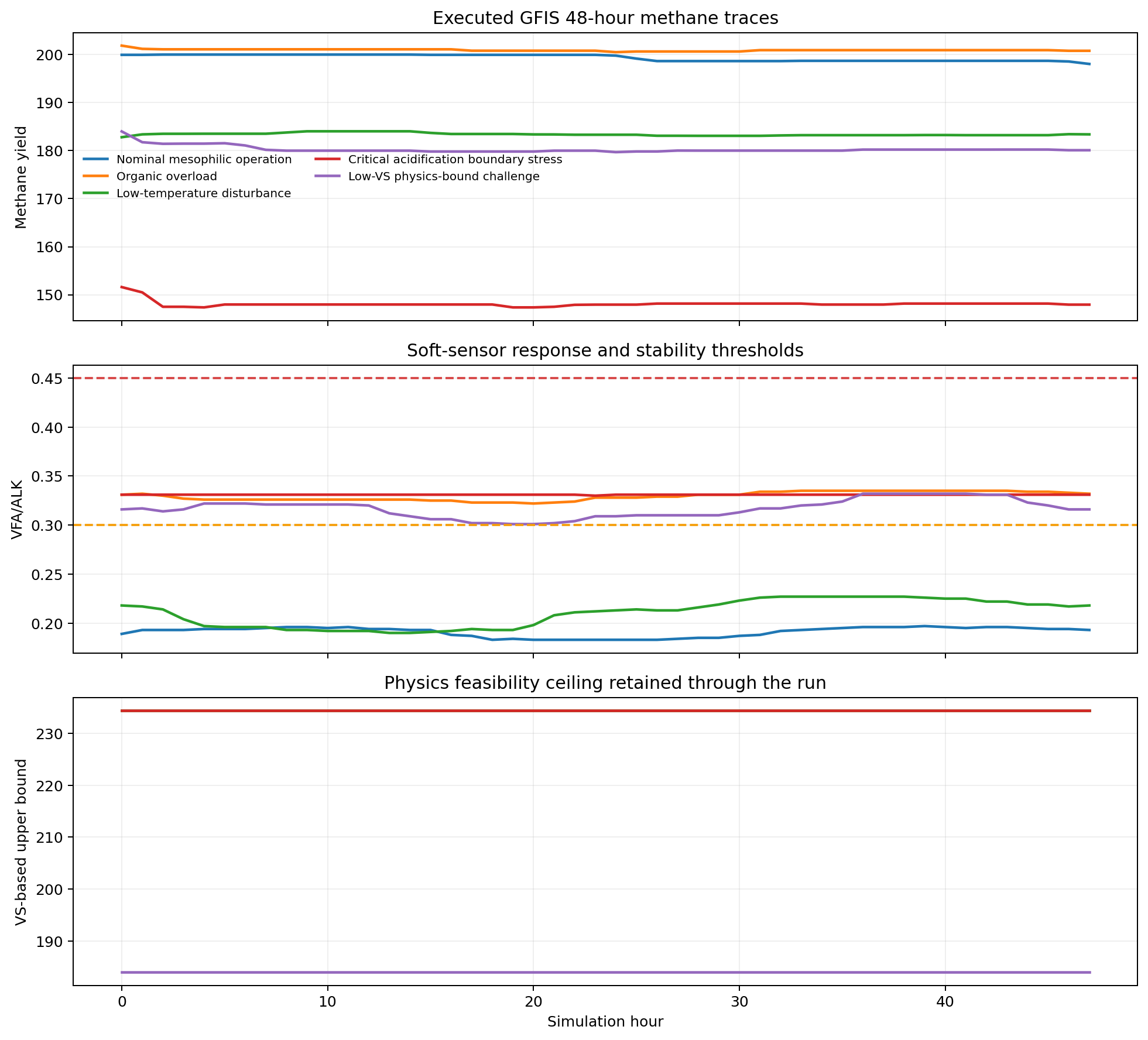
Executed from the trained Python service. The low-VS boundary challenge records a physics violation before correction; organic-overload conditions maintain a warning-state VFA/ALK response.
Open complete traces Open scenario summary Open run metadata
Control Room: model-backed decision surface
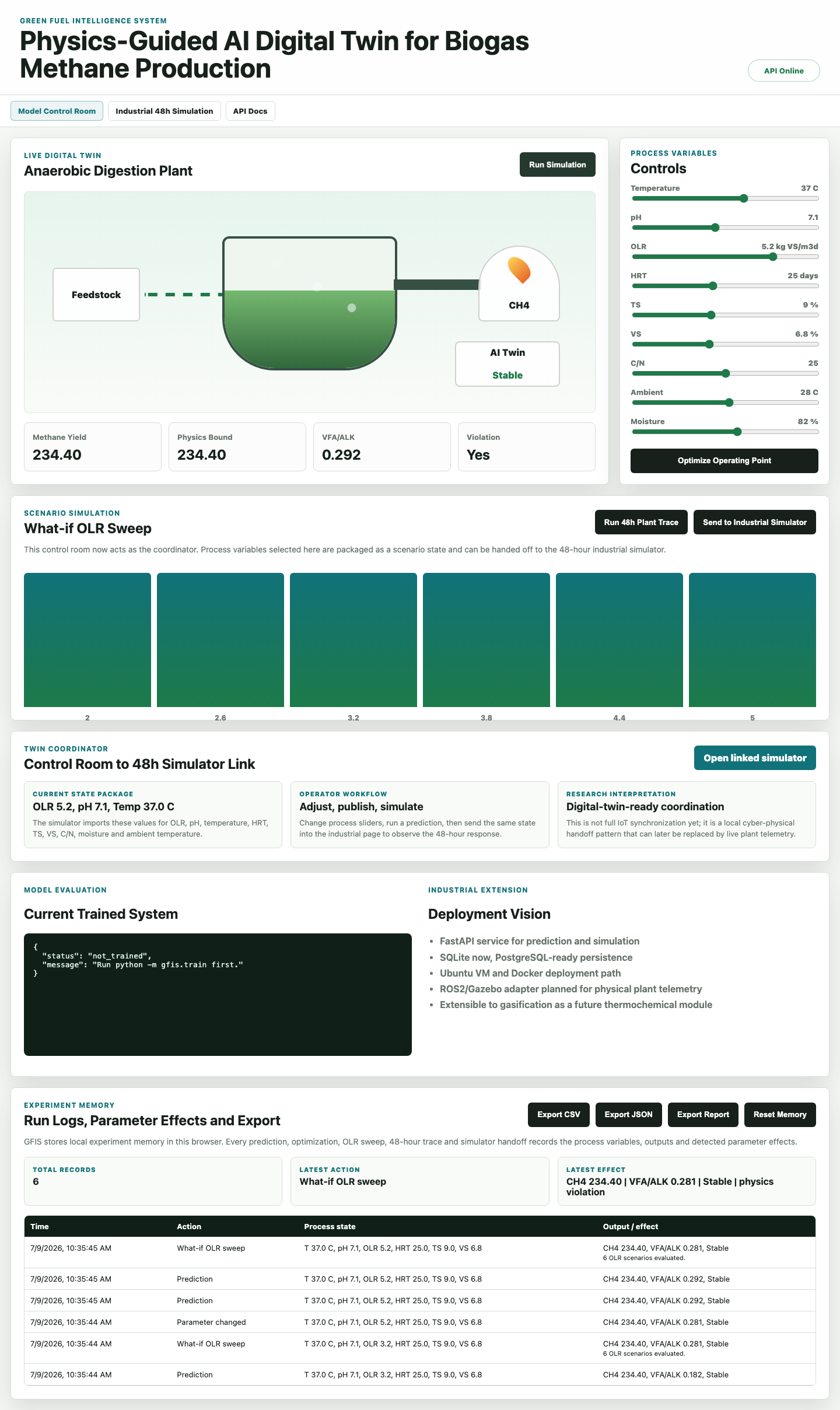
Historical localhost capture, 9 July 2026. Operators change temperature, pH, OLR, HRT, TS and VS; GFIS displays methane, physics bound, VFA/ALK, violation state, scenario sweep and exportable run memory. The historical “not trained” panel is superseded by accepted replay metadata confirming the trained bundle loaded.
Visible input-to-output path
Every operator input is shown beside methane prediction, physical ceiling, VFA/ALK estimate and stability interpretation. Scenario state can be sent directly to the industrial simulator.
Experiment memory
Prediction, optimization, sweep, 48-hour trace and simulator handoff records retain parameters, outputs and effects for CSV, JSON and report export.
Industrial simulator: state propagation and alarms
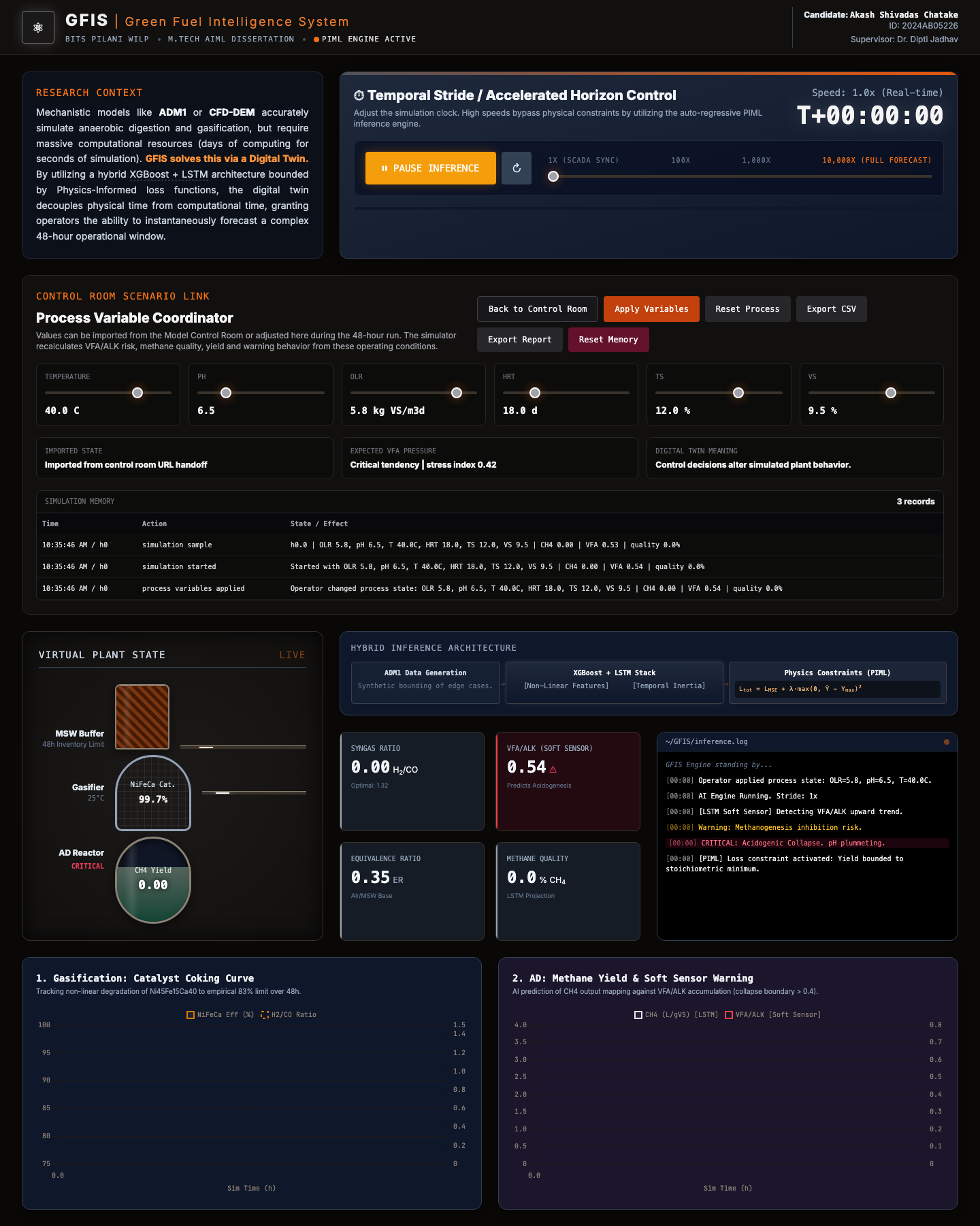
Historical localhost capture, 9 July 2026. The simulator receives the Control Room state, recalculates methane and VFA/ALK behaviour, records warning/critical interface states and exposes simulation-memory export.
| Operator variable | Biological interpretation | GFIS visible response |
|---|---|---|
| Temperature | Microbial-rate and mesophilic-efficiency change | Methane trajectory and drift response |
| pH | Acidification or inhibition risk | Yield reduction and stability message |
| OLR | Organic overload and VFA accumulation pressure | VFA/ALK warning and scenario comparison |
| HRT | Contact time and washout risk | Temporal methane response |
| TS / VS | Substrate and biodegradable-solids availability | Yield response and methane feasibility ceiling |
Product evidence versus plant validation
Supported now
- Executable methane prediction
- Stateful multi-hour simulation
- VFA/ALK warning behaviour
- Physics-bound detection
- Scenario handoff and export memory
Requires plant/shadow-mode data
- Industrial methane accuracy
- Measured VFA/ALK calibration
- Sensor uptime and latency
- Operator warning precision
- Closed-loop control performance