Evaluator-suggested public evidence
Dated March–July observations retain reactor identity and measured process fields.
Methane is calculated only where total biogas and methane fraction coexist in the source.
One-minute full-scale SCADA supports observed plant replay. Its Biogas channel is total biogas in CFM—not methane.
Leakage-safe experiment design
What training is allowed to see
Only observations earlier than the current validation block. Imputation medians, scaling statistics, lag features and sequence windows are fitted or constructed within the training chronology.
What training cannot see
No random shuffle, no validation-fitted preprocessing, no test-period model selection, no future target in lag features and no cross-reactor sequence mixing.
Epoch-by-epoch measured-methane training
This figure is regenerated from run TE-DS05-20260724T212528Z. Every line is a retained training session identified by rolling fold and seed. Click to enlarge it.
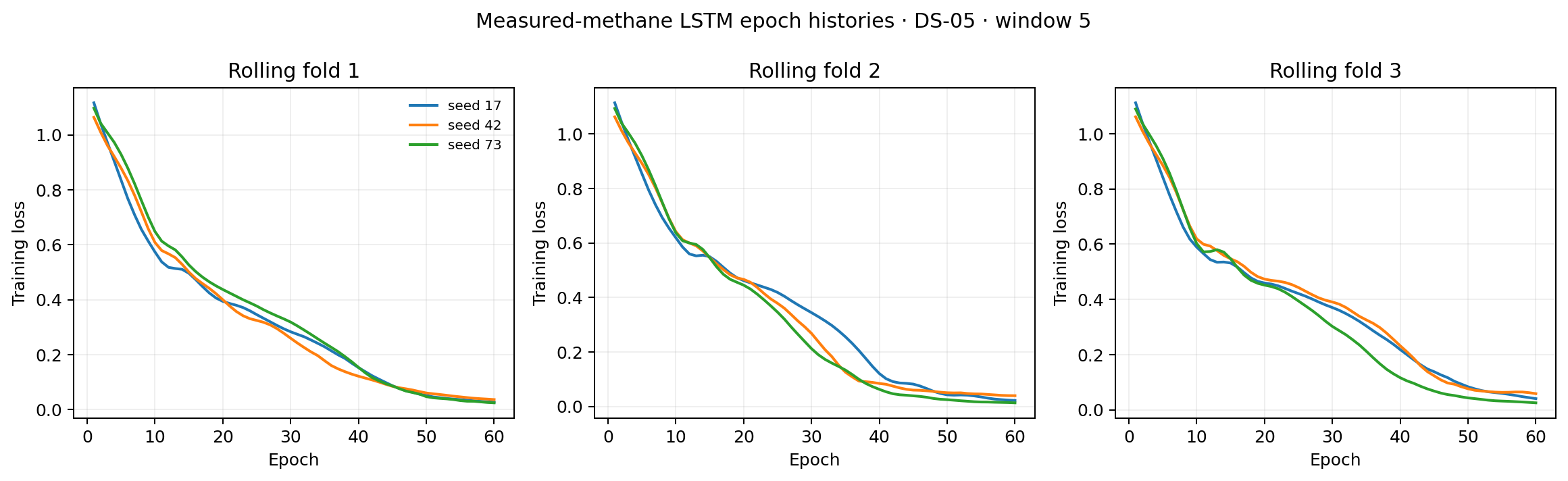
Actual DS-05 LSTM training-loss histories for the five-observation window. Training loss explains optimisation behaviour; architecture selection still uses rolling-origin validation metrics.
Configuration
- Measured-methane target
- Sequence window 5
- Maximum 60 epochs
- Seeds 17, 42 and 73
- No random time-series shuffle
- Past-only features and chronological folds
Why the baseline matters
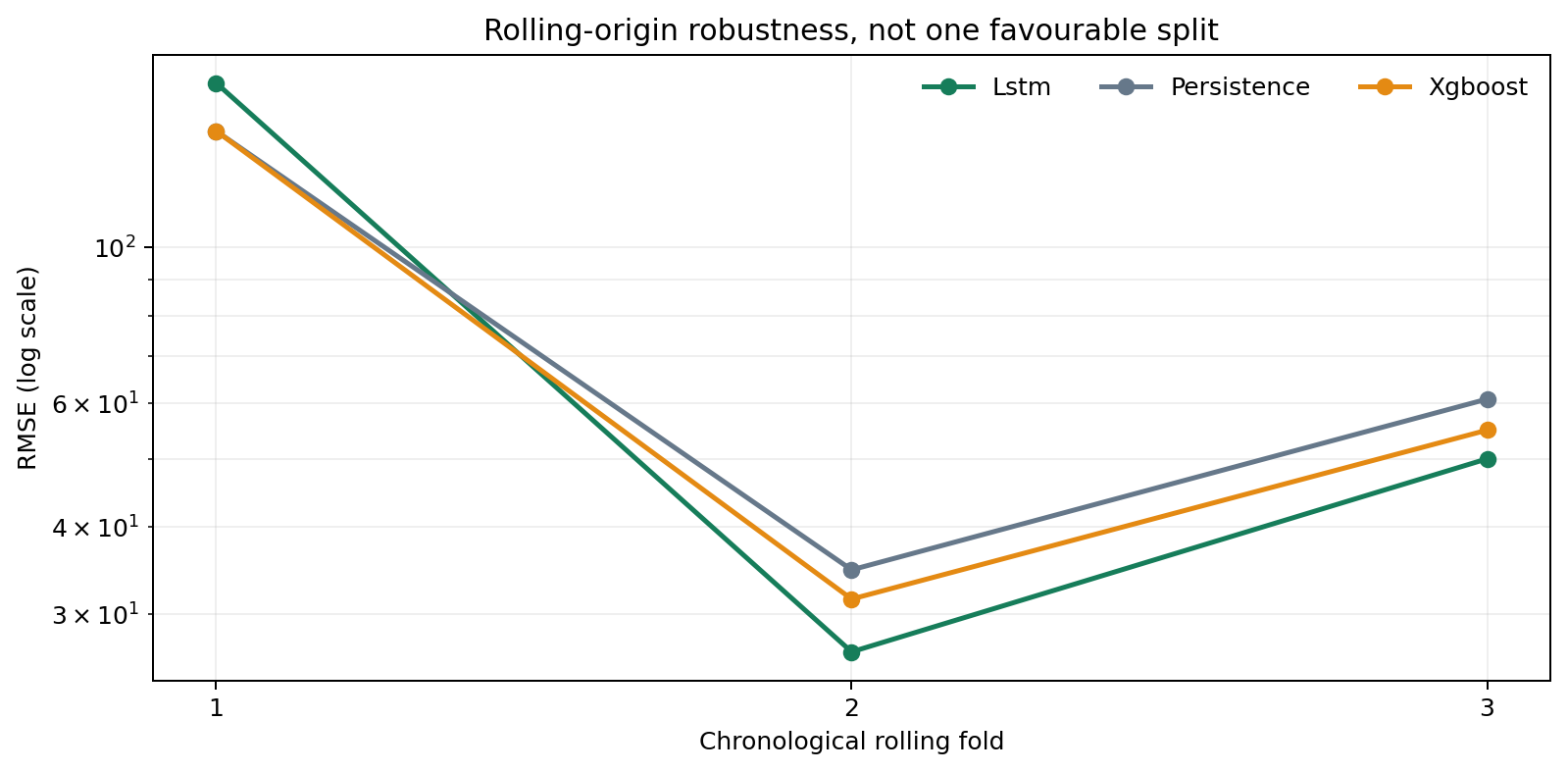
Across rolling-origin DS-05 validation, no temporal architecture receives promotion from one favourable score.
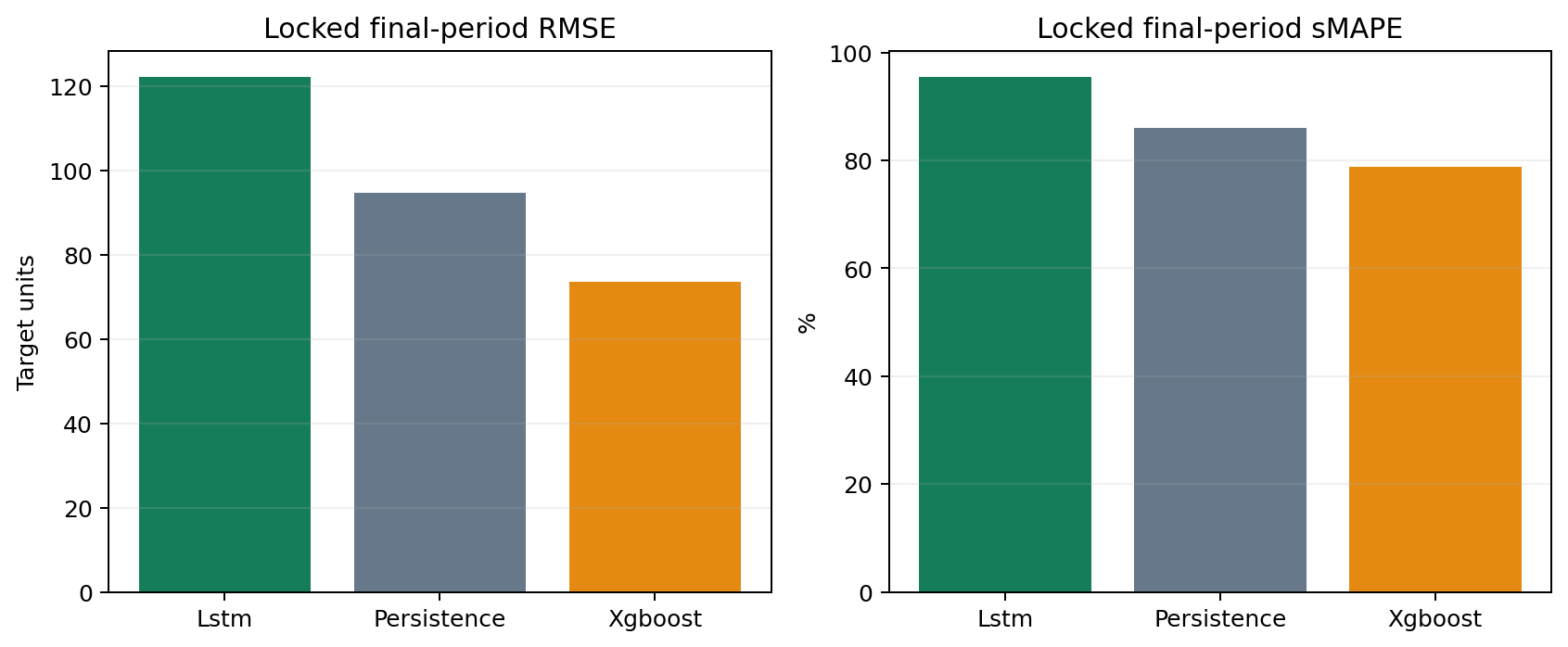
On the untouched final period, XGBoost has the lowest mean error across repeated seeds; the LSTM loses to both required baselines.
Architecture decision
XGBoost is the final-test leader, while rolling-origin average RMSE remains close to persistence. The compact LSTM stays a research challenger—not the production champion. Longer memory or Transformers are not justified by this run.
What the 500,400-row study adds next
Industrial chronology
Nearly one year of one-minute temperatures, feed, level and total-biogas signals exposes operating transitions absent from the smaller reactor study.
Benchmark boundary
The next experiment must reproduce the published 491,761-row cleaned set before fitting persistence, XGBoost or LSTM models.
Plant replay
The indexed raw chronology already drives the 3D plant as observed SCADA. Model output and simulator output remain separately labelled.